
Early versions of AI promised to expand our horizons. By breaking habits and lazy search routines, these platforms touted discoveries that would align with preferences while simultaneously extending them. Is that where we ended up? Today, most of the AI-platforms directing our behaviors are designed to close loops, not open them. They don't push us toward the edges. They pull us toward the center, toward what's familiar.
Pre-AI, pre-internet really, information crashed into people’s lives like arcade asteroids, careening in from all directions often from unexpected angles. Guarded by today’s algorithmic iron dome, fewer unfamiliar or disagreeable stimulants make it through, and rarely do we enjoy a dispatch from an unexpected angle. Our surface area for colliding with new stuff is shrinking fast.
Last week I spoke to a group of entrepreneurship students at Northeastern University (Go Huskies!). Unsurprisingly, they wanted to know what, given how AI is changing everything, what could they do to best navigate it?
I was glad to share this: Break your algorithm. Increase your surface area. Above all, seek out collisions.
Citation alert: I’ve borrowed most of philosophy on collisions from Zappos’s founder Tony Hsieh.
I spent time with Tony when starting my own entrepreneurial journey, a time when he was rapidly approaching the zenith of his.
We first met in 2008. Tony had DEEP feelings about the connections between happiness and innovation, personal wellbeing and collective success. As those principles ran their course at Zappos, it led Tony to explore these ideas well beyond Zappos HR policy. A few quick years later, Tony had sold Zappos to Amazon and has launched the Downtown Vegas Project, a visionary effort to transform downtown Las Vegas into a BioDome for entrepreneurship. I was lucky to follow along as this ambitious experiment unfolded—it impacted me in ways that I still can’t fully compute.
Tony’s vision for how entrepreneurship unlocked human potential was unparalleled. How that vision tortured him—and the collateral damage left in its wake—is also an important story, but it’s not mine to tell. Putting aside the tragic ending to Tony’s life, his philosophy on the power of collisions was transcendent. It was also top of mind when pressed for guidance by those young entrepreneurs at Northeastern.
Tony was obsessed with the idea that all environments, activities, everything should facilitate, accelerate and nurture collisions, even if it’s laborious or uncomfortable. He believed the real magic of a community — or a company, or a career — doesn't come from planning. It comes from collisions: unplanned encounters between people and ideas.
Instead of talking about ROI, Tony talked about ROC, Return on Collisions. He knew you can't schedule serendipity. But believed you could engineer the odds of it.
The secret was in the surface area. How many different people, places, problems, and perspectives are you actually exposed to? More surface area, more collisions. More collisions, more of the kind of "luck" that isn't really luck at all. Surface area as secret weapon.
Here's what I told the students: their generation is increasingly vulnerable to diminished surface area and thus, deeply at risk for the downsides of what I call a collision deficit.
This isn’t because they're less curious. It’s because the algorithms now underpinning our daily lives go to great lengths to avoid displeasure. To avoid collisions.
I've had a career that spans different industries, with every pivot tracing back to a collision I didn't plan, a room I wasn't sure I belonged in, a person I had no obvious reason to meet. Collisons made me. The best example I have isn't from business at all. It’s from boxing.
When I won my first amateur bout at the Showboat Casino in Atlantic City, nobody saw it coming, certainly not me. Three rounds of frantic, refereed punching didn’t seem connected to my professional journey as an early stage investor. Yet, there’s no doubt now that boxing made me a better investor.
It wasn’t about punching. Not about bobbing and weaving. It’s simply because boxing put people in my path I’d never have otherwise met. Example: one of my coaches recently retired as deputy warden at the Department of Corrections. Her decades of experience within the penal system taught me all kinds things that weren’t on the agenda at a start-up happy hour.
Boxing was a transformative collision, literal and figurative. Students, entrepreneurs, all of us, would be wise to tune into the difference between a collision and an echo. The difference between something that affirms you and something that changes the way you see the world or how you behave in it. Collisions leave a mark, sometimes a scar.
If algorithm's default is to narrow the view, the burden is on us o widen it. I gave the same advice to the students as I often give to founders today:
Go to a room you think you don't belong in. A conference outside your industry. A community meeting. A lecture on something you know nothing about.
Pick up something you're bad at. Being a beginner is the fastest way to meet people who have nothing to do with your day job, a lesson I learned the first time I got punched in the face.
Break your feed. Search for things instead of waiting to be served. Read the section you always skip. Let someone else pick the playlist, the restaurant, the book.
Say yes to the weird invitation. The ones that don't fit your plan are often the ones that change it.
Talk to people who aren't "useful." Collisions don't pay off on a schedule. The person with no obvious link to your goals may be the one who has what you need. My boxing coaches were there for me when I needed help with my life, not a term sheet.
Be curious out loud. Ask the question. Tell people what you're working on. Surface area isn't just where you go — it's how open you are once you’re there.
Nobody knows what the future may hold. Here’s what I do know: our plans will be wrong. But a strong network, built from expanded surface area and lots of collisions, will be the best weapon you’ll have to deal with it, in real time.
So, thank you, Tony. Thank you for the nights in Vegas when hundreds of us danced around the sculptures you dragged back from Burning Man, turning an empty parking lot into a fairytale. Thanks for handing me your half-eaten burrito, just mere seconds after a life coach told me that I needed to “loosen up.” Thanks for organizing your real estate purchases so that the boundaries took the shape of your pet llama—what a map that really was.
More than anything, thanks for your intellectual generosity, making it soooo easy for me to pass your wisdom on to those kids at NU last week.
Collide or die? Collide.
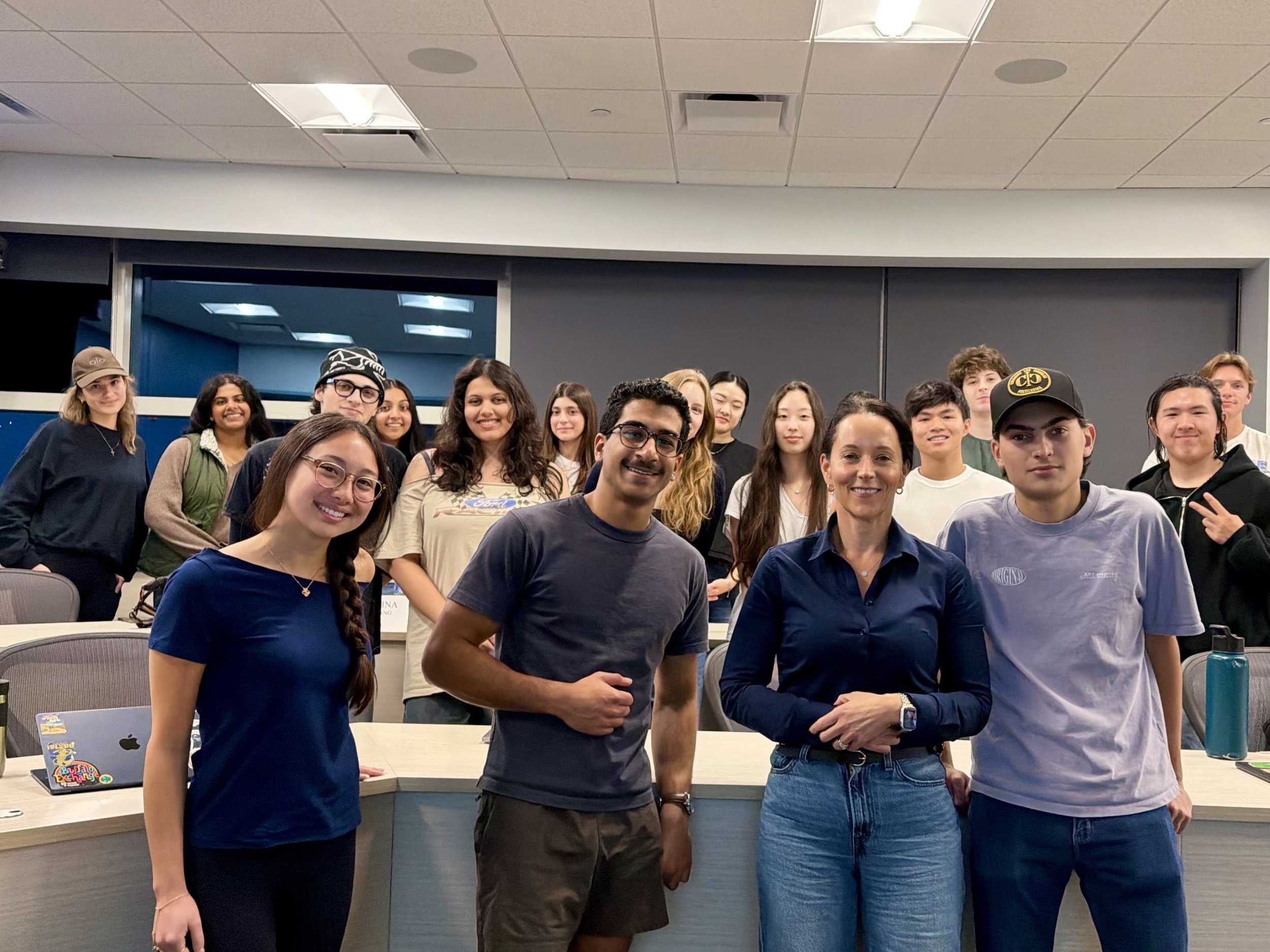
Thanks Northeastern for having me!
———
More About RevUp Capital
RevUp Capital invests in B2B and B2C companies that are revenue-driven and ready to double down on growth. We deploy cash and capacity to help companies grow from $1-3M to $10-30M, quickly and efficiently, using a revenue-based model. Companies enter our portfolio with $500K-$3M in revenue, a strong growth rate, and a team that’s ready to scale. Our typical investment range is $300K-$500K.
Learn More at www.revupfund.com
How We Invest
We built RevUp to invest into B2B and B2C companies ascending the $1M-$10M growth curve. We know from experience—and from the stellar performance of our portfolio—that this curve can be conquered. But, having the right resources and support along the way is critical to success.
RevUp combines non-dilutive investment with hands-on support to help companies build stronger, more scalable infrastructure for growth. And, we do it using a non-dilutive model. Our goal? Give companies the best shot at success while preserving founder equity, optionality, and autonomy.
For more info visit here.
More About the Author
RevUp Capital Managing Partner Melissa Withers is a bullish advocate for innovating the ways in which new companies are funded and supported. Beyond building new economic models for early stage investing, Melissa is also committed to directing more entrepreneurial funding to those underserved and overlooked by traditional VC.